


October 2012, a note by the editor of ForestIndustries.EU: Although we wrote this article years ago, recent studies proof us to be right. The study "Forests or Agriculture: not necessarily an ‘all or nothing’ trade-off" came up with some interesting conclusions although the authors put higher emphasis on "emission reductions" than an "povertry reductions"... (read here as well);
As of December 2012: First time we can read that forests are key to protecting economic growth and social progress and a landscape-based approach, which looks at the synergies and trade-offs of managing a broad resource mix, has been hailed as a new way to bring together the agricultural, forestry, energy and fishery sectors to better manage the world’s resources while offering opportunities for climate adaptation and mitigation.
As of November 2013: “Zero” deforestation targets misleading, say experts. Targets set by governments and others to cut deforestation can be misleading and might not save as much rainforest as intended, undermining the fight against climate change, scientists say in a review published on Thursday.
“Until targets are clarified, and metrics agreed upon, zero may mean nothing at all,” say authors Sandra Brown, director of ecosystem services at U.S. environmental services firm Winrock International, and Dan Zarin, programme director of the Climate and Land Use Alliance....read further here...
Many industrialized countries base their economies on past deforestation. Some of those have learned their lessons over time and have sustainably taken care of their natural resources and landscape by sophisticated land use planning – Central European countries like Austria and Switzerland.
Therefore let us learn from theses countries on how to treat the issues of land use change and forest degradation. Deforestation and economic utilizing of natural resources can be done without seriously harming the environment and rural people by simultaneously protecting high conservation forests and mitigating natural hazards.
Some historic background
 |
Shifting cultivation from forests to other land uses has been done since mankind settled as farmers. The earliest record of major anthropogenic deforestation was found in Ghab Valley, northwest Syria. Pollen analytical studies on the sediment core from the Ghab Valley detected a large-scale anthropogenic deforestation of deciduous oak forest as early as 7000 B.C.
Some of these activities had been crucial to their civilizations, some of them not. Gilgamesh gives you an idea of a less successful deforestation activity – as mentioned above…
A different story on reclaiming land can be told about Europe. Europe – in particular central Europe was a heavily wooded region in ancient times. Romans can tell you a thing or two about ancient forests in Europe (not to mention the battle at Teutoburg Forest). Publius Cornelius Tacitus (1st century A.C.) wrote about Germania Magna (central Europe): “terra aut silvis horrida aut paludibis foeda” – “a country covered by horrible forests and abhorrent bogs”. Pollen analytical studies on the sediment core of various central European sites came up with an average forest land cover of more than 80% in Stone Age era.
Since then, mankind started to shift cultivation from forests to agriculture (or even much earlier... or a bit later)
Since then the forests of Europe have been logged for various reasons.
At the beginning and for long time because of the needs for agricultural land, later the needs changed and people logged forests because of the wood.
.jpg) |
Forest cover declined permanently and reached its all time low in the Industrial Age. Some sources argue that forest cover has achieved a level as low as less than 20%. The switch from charcoal to black coal was generally agreed to be the watershed for the deforestation rate (which happened mid 18th century).
Henceforth forest cover started to recover in Central Europe. Because of steady growth of forest cover since then, Central Europe has reached a forest cover of ~ 38% nowadays (some countries like Austria have recovered to a notably share of nearly 50%).But long time before deforestation rate peaked in Central Europe, people started to suffer from environmental issues. As early as in the 16th century they started to think on how to prevent natural hazards and on how to sustain the ecosystem services of forests.
The idea of sustainable forest management and land use planning was born when H.C. von Carlowitz published his book “Sylvicultura Oeconomica” in 1713.
So Central Europe has had the chance to learn a lot regarding the impact of deforestation and land use change…
The ratio behind deforestation
Blaser and Robledo did a global survey on the drives of deforestation. Not surprisingly, but currently little recognized by environmentalists, Blaser and Robledo found agricultural land use after forest clearing as the biggest driver of deforestation (read also here). Only one third of deforestation is done because of wood utilization (=logging).
 |
|
Deforestation objectives and deforestation area in million hectares/year for the period 1990 - 2005, published by Blaser and Robledo, 2007 |
Post-forest clearing uses such as commercial agriculture and ranching can generate attractive ongoing cash flow after trees are cleared from the land. The value from post-forest clearing land use is typically even greater than the value of the standing timber and will drive deforestation even where forest resources are not themselves commercially valuable.
National and local policymakers have a responsibility to their home constituencies to promote social and economic development.
Because forested land can generate greater economic value when put to other uses, individuals and companies in developing countries face powerful incentives to exploit these opportunities. Today’s richest countries, such as the Central European countries, actively pursued deforestation and land conversion to agriculture in early phases of development for exactly these reasons.
So the ratio behind deforestation is most likely (~75% of global deforestation) to generate higher value from land use paired with people thinking new land use would generate the expected higher value everlasting.
Grieg-Gran within the Eliasch report:
 |
|
Returns are net present value in 2007 $ at discount rate of 10 per cent over 30 years |
Deforestation occurring because of fuel wood needs of local people has to be seen differently (~11% of global deforestation). This issue is clearly associated to the poor and is a classic part of non-sustainable forest utilization because of growing social pressure based on population growth.
Remaining 14% of global deforestation is based on sole value generation by nonrecurring commercial timber logging without any intention for further use of the land.
The three main drivers of deforestation:
|
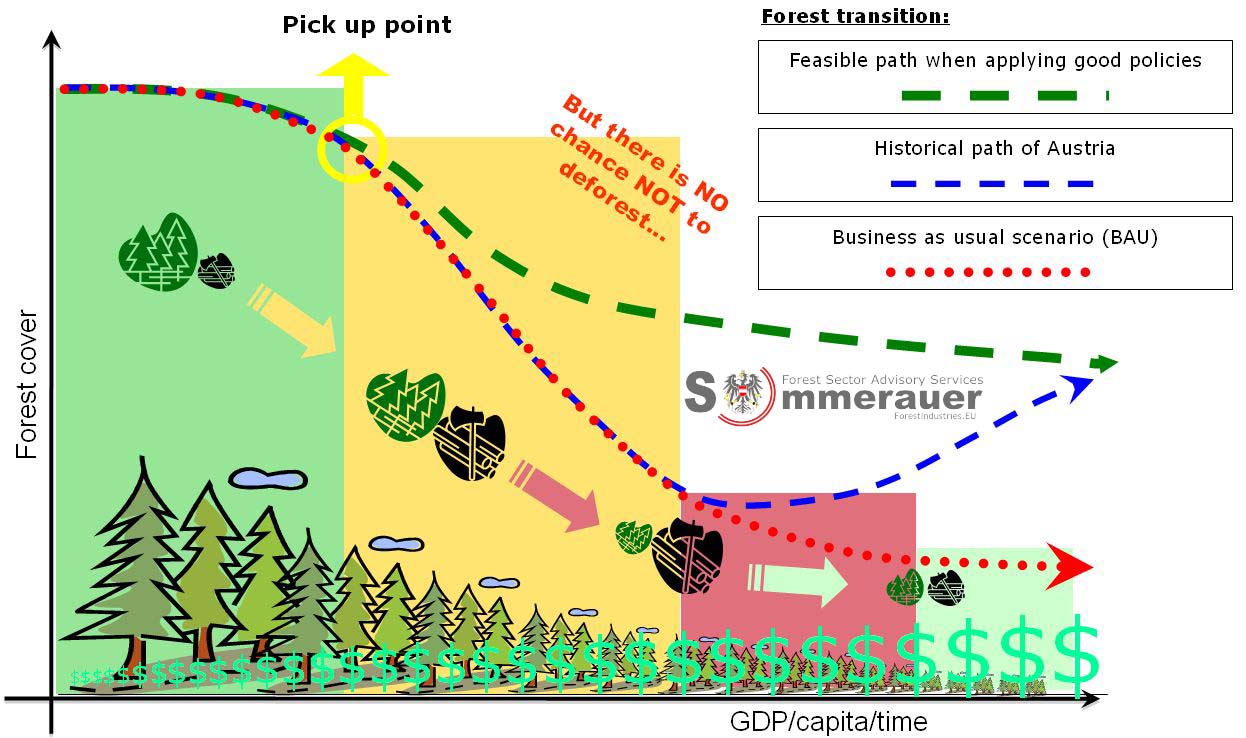
The forest area change may follow a pattern suggested by the forest transition (FT) theory, whereby at early stages in its development a country is characterized by high forest cover and low deforestation rates (HFLD countries). Then deforestation rates accelerate (HFHD), and forest cover is reduced (LFHD), before the deforestation rate slows (LFLD), after which forest cover stabilizes and eventually starts recovering. FT is influenced by national context (e.g., human population density, stage of development, structure of the economy), global economic forces, and government policies.
Forest cover and income (GDP) per capita are variables to capture a country’s stage in the FT. Countries with high forest cover can be expected to be at early stages of the FT. GDP per capita captures the stage in a country’s economic development, which is linked to the pattern of natural resource use, including forests. The choice of forest cover and GDP per capita also fits well with the two key scenarios in the FT:
|
A country may reach very low levels of forest cover before it stabilizes, or it might through good policies be able to “bridge” the forest transition.
 |
|
Forest cover and GDP – a strong relationship in the long run |
Places experience forest transitions when declines in forest cover cease and recoveries in forest cover begin (blue path). This is the usual historic path Austria has undergone in the past. The gap of the blue path happened in the mid of the 19th century – up from then, forest cover started to recover in Austria.
Before this, Austria faced massive deforestation and forest degradation issues within and outside the mountainous area of the Alps.
|
Deforestation was mainly driven by shifting cultivation to pasture and other agricultural land use. The vast majority of forest degradation happened because of
|
Extend, manner and reasons of historic deforestation and forest degradation in Austria was quite similar to ongoing processes in nowadays developing countries.
Current awareness and knowledge regarding deforestation
The Bali Action Plan calls for: “consideration of policy approaches and positive incentives on issues relating to reducing emissions from deforestation and forest degradation in developing countries; and the role of conservation, sustainable management of forests and enhancement of forest carbon stocks in developing countries.
Agenda 21 adopted at the United Nations Conference on Environment and Development
(UNCED) recognized the need to strengthen forest-related national institutions, to enhance the scope and effectiveness of activities of the management, conservation and sustainable development of forests, and to effectively ensure the sustainable utilization and production of forests’ goods and services in both developed and developing countries.
Additionally, while the direct and indirect drivers of deforestation and degradation are well known, there is limited knowledge regarding the relative effectiveness of alternative approaches to reversing those drivers under different national circumstances. Despite several decades of investment in efforts to reduce deforestation and degradation, there remain few examples of rigorous impact assessment, monitoring, and evaluation that would enable specific outcomes to be associated with specific interventions.
There is thus an urgent need for the design of new investments in improved forest management to incorporate an explicit learning agenda to close this knowledge gap.
Forest cover loss to agriculture might not be a disaster and Forest degradation can be avoided
Blaming countries for land use change in general (which in most of the cases happens) is counterproductive. Deforestation is quite often seen as an act of irresponsible depletion but was a main driver for economic growth in the past to a lot of nowadays industrialized countries.
Just ask yourself some questions:
Which of those countries having benefitted from deforestation in the past is entitled to blame those doing the same nowadays?
Is providing compensation payments in substitution of deforestation the right vehicle to concede national sovereignty to those countries?
Isn’t it a better idea to let those countries cope their economic upturn by their own utilizing their own natural resources?
Isn’t it a better idea just to provide the experience in sustainable utilization of natural resources gathered by some industrialized countries to them? By supporting them in sustainable management of land use change and prevention/mitigation/restoration of forest degradation?
Social and economic pressures make it inevitable that substantial area of what is still natural forests today will be converted to agriculture and other uses.
Land use change and forest resource utilization must be accepted as a basic right to every country. Both are not bad in general. Both have supported economic upturn of a lot of nowadays industrialized countries.
Land use change as well as forest resource utilization might not harm environment nor society as long as they are well managed. And there are a lot of countries like Austria, who have got in-depth experience accumulated for hundreds of years on how to manage low impact land use change and forest resource utilization.
The results of low impact land use change and forest resource utilization
Austria’s journey in land use change and forestry started with high forest cover (estimations of 75 – 80%) at early middle ages.
Besides timber logging to a minor degree, forest utilization was mainly based on livestock grazing during medieval times. Grazing was therefore one of the first extensive causes of land use change in Austria (mountain pasture as well as lowland pasture). Cultivation shift was done quite sustainable – as most agriculture land established in those times, is still under use without any yield degradation.
Non-sustainable logging of timber for smelting, saltern and household heating/cooking done during industrialization phase resulted in massive natural hazard drawbacks throughout the whole mountainous regions. Some valleys have been temporary depopulated because of recurring avalanche hazards.
When industry switched from charcoal to black coal in the mid of the 18th century, deforestation and forest degradation rate declined and forest transition started in Austria.
Implementation of comprehensive land use planning and establishment of a sophisticated forest administration system was part of Austria’s forest transition progress. Besides this, Forest transition went along with the establishment of a strong and powerful timber processing industry.
Nowadays Austria’s forest cover is back to ~ 50% and Austria is top ranked in:
|
Sustainable deforestation and forest utilization is feasible
Austria proved sustainable deforestation and forest utilization as economical viable without being a threat to environment and society – even under Austria’s adverse conditions of high human population density and a large portion of mountainous regions.
It is the order of the day to those countries which are well grounded in handling land use change and forest degradation to support developing countries by
|
“Just paying money for reducing deforestation and improving conservation practices measured by environmental records like carbon sequestration will not solve the problem – it will still worsen it.
Our approach would foster economic development, not dependency”
Countries like Austria or Switzerland are ready to assist countries battling with deforestation, land use change and forest degradation by supporting well planned, selective deforestation (which might lead to less deforestation) for a sustainable development of rural areas and proper management of forest resources either degraded or not.
- Interested in this topic? Read more here...
-
Some intersting information regarding Austrian Forests and Austrian System of Sustainable Forest Management you will find here...(
 PDF, 8 MB)
 - There are implications on deforestation and underutilized agricultural areas... this topic is much more complex as it seems to be at prima facie...
- If you want to learn why conservation can not be the deal within REDD+ then continue to read here...
- There is a very interesting article about India with regards to the question "Can you love tigers but hate forests?"
- CIFOR has published an interesting brief on options
- After having written our article almost 2 years ago, people are starting to think about our concerns: REDD+, forests and food
- What you might not have known about forests and food security
- 2012: Environment special: Deforestation and forest degradation
- Moving REDD+ forward: more structured discussion on the drivers of deforestation is needed
- Sustainable Land use in 21st Century
REDD and forest transition: Tunneling through the environmental Kuznets curve
May, 2012. Richard J. Culas. Ecological Economics. Early View (Articles online in advance of print). http://dx.doi.org/10.1016/j.ecolecon.2012.04.015
Summary
International attention is focused on finding ways to reduce emissions from deforestation because of the emerging concerns over climate change. However the causes of deforestation are rooted in current economic and development paradigms. The causes of deforestation also vary across different geographical regions and have implications for the forest transition.
Attempts to reach an international agreement on curbing deforestation have achieved little success despite over 30 years of UN negotiations. New initiatives from REDD (Reducing Emissions from Deforestation and forest Degradation) could provide financial incentives to curb deforestation. Hence, alternative development paths for forest cover changes and forest transition are analyzed for the REDD policy within the framework of an environmental Kuznets curve (EKC) for deforestation. The EKC models are estimated for geographical regions of Latin America, Africa and Asia.
The results based on the panel data analysis of 43 countries, covering the period 1970–1994, provides evidence that an inverted U-shaped EKC fits for Latin America and Africa, while a U-shaped EKC applies to Asia. The results also indicate that strengthening agricultural and forestry sector policies are important for curbing deforestation. The EKC models’ estimates could provide guidance for decisions on financing the REDD policy as specific to each region.
Please click here to view access details.
Agricultural expansion: an “either or more” factor in deforestation
October 4, 2012. CIFOR
Summary
Pastureland has been identified as the leading driver of deforestation in many parts of Latin America.
But when considering alternative land uses – like the growing of soya beans and oil palm – it’s not necessarily an “either-or” question, says Pablo Pacheco, a scientist with the Center for International Forestry Research.
Much of the land used for agricultural expansion occurs on pastures formerly used for ranching, he said. Those who have been “displaced” often tend to cut down forests in search of new land to till or graze.
So, in terms of sustainable development, Pacheco notes, it’s rarely a question of “do we want more grazing pastures or land for agriculture.”
Rather, he says, the discussion ends up being “either [pasture] or more [pasture carved out of the forest by ranchers that have been displaced by agricultural expansion].”
Instead of arguing about which activity causes more tree loss, policy makers should focus on “a combination of measures to close the frontier and improved land management in already consolidated agricultural frontiers. Higher social inclusion is also required.”
An assessment of deforestation and forest degradation drivers in developing countries
October 8, 2012, IOPScience
Countries are encouraged to identify drivers of deforestation and forest degradation in the development of national strategies and action plans for REDD+. In this letter we provide an assessment of proximate drivers of deforestation and forest degradation by synthesizing empirical data reported by countries as part of their REDD+ readiness activities, CIFOR country profiles, UNFCCC national communications and scientific literature. Based on deforestation rate and remaining forest cover 100 (sub)tropical non-Annex I countries were grouped into four forest transition phases. Driver data of 46 countries were summarized for each phase and by continent, and were used as a proxy to estimate drivers for the countries with missing data. The deforestation drivers are similar in Africa and Asia, while degradation drivers are more similar in Latin America and Asia. Commercial agriculture is the most important driver of deforestation, followed by subsistence agriculture. Timber extraction and logging drives most of the degradation, followed by fuelwood collection and charcoal production, uncontrolled fire and livestock grazing. The results reflect the most up to date and comprehensive overview of current national-level data availability on drivers, which is expected to improve over time within the frame of the UNFCCC REDD+ process.
Read further here (or download PDF)
---------------
Don't Demonize Deforestation - sovereignty matters as well!
